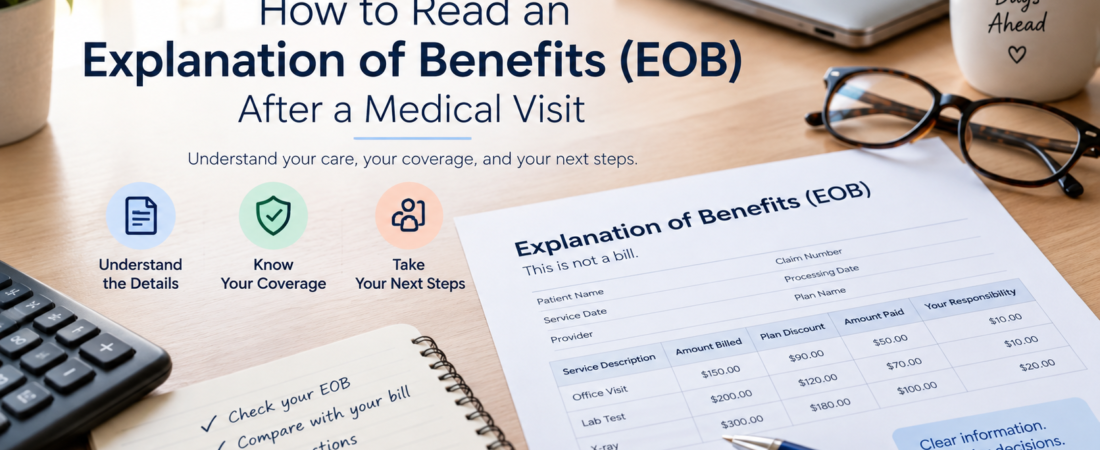
Learning how to read an Explanation of Benefits (EOB) can help you distinguish the provider’s charge, the amount recognized by your health plan, and the amount the insurer assigned to you. An EOB is usually not a bill. It is a claim statement from your insurer explaining how a visit or other service was processed.
Read it in this order: verify the claim and services, follow the insurer’s calculation, check how the claim affected your deductible or other limits, and compare the result with the provider’s bill. If something is unclear, contact the provider or insurer promptly—especially if a bill has a payment deadline.
What an EOB tells you
Labels and layouts differ among insurers, but an EOB commonly includes:
- The patient, member or subscriber, provider, and date of service
- The services or procedure codes submitted on the claim
- The provider’s billed charge
- The allowed amount, negotiated rate, or other amount recognized under the plan
- Adjustments, discounts, or excluded amounts
- The amount paid or applied by the insurer
- Deductible, copayment, and coinsurance amounts
- The patient-responsibility amount calculated for the claim
- The claim’s status and explanation or adjustment codes
An EOB’s wording can be technical. “Allowed amount,” “negotiated rate,” and “eligible expense” may describe related concepts, but they are not interchangeable in every plan. Use the definitions in your plan documents or ask the insurer about a term that affects your claim.
How to read an EOB step by step
1. Confirm the claim information
Check the patient’s name, member information, provider, place of service, and date. If the claim concerns a dependent, confirm that the dependent is listed correctly. Note the claim number before calling the insurer; it helps the representative locate the specific claim.
One visit can generate several claims. For example, a hospital encounter may produce separate claims from the facility, physician, radiology group, anesthesiology group, or laboratory. More than one EOB and provider bill may therefore be legitimate.
2. Review each service line
Most EOBs list services in rows. A line may show a brief description, procedure code, provider, date, and place of service. Compare unfamiliar entries with your appointment records, discharge paperwork, test orders, or provider statement.
An unfamiliar line is not automatically an error. A test ordered during an appointment, a professional fee, a facility fee, or a laboratory charge may be submitted separately. Ask the provider’s billing office to explain any service you do not recognize, preferably in plain language.
3. Separate the billed amount from the allowed amount
The billed amount is what the provider submitted. It is not automatically the amount used to calculate your cost or the amount you should pay.
The allowed amount is the amount the plan recognizes for the service under its rules. For an in-network provider, it commonly reflects a negotiated rate. For example, a provider might submit $250, while the plan lists an allowed amount of $150 and a $100 adjustment. If the service is covered and the provider is in network, cost sharing may be calculated from the $150 rather than the original $250.
This example does not predict what another plan will pay. Deductibles, exclusions, authorization rules, network status, and the type of service can change the calculation.
4. Find the plan-paid amount and adjustments
Look for the amount the insurer paid or applied to the claim. The EOB may also show adjustments, discounts, or the amount applied to your deductible. For example, the insurer may pay part of the allowed amount while assigning another part to your deductible or coinsurance.
Read the adjustment or explanation codes beside the figures. They may explain that a service was bundled with another service, reduced, excluded, denied, or assigned to you. If the reason is abbreviated, use the notes section or ask the insurer to translate it.
5. Identify patient responsibility—but do not treat it as an automatic bill
The EOB may divide the insurer’s calculation into categories such as:
- Deductible: the amount applied to the plan’s deductible.
- Copayment: a fixed amount assigned for a covered service when the plan uses a copay.
- Coinsurance: a percentage of the plan’s recognized cost when applicable.
- Noncovered or excluded amount: an amount the plan did not cover under the claim rules.
- Other responsibility: an amount assigned to the patient for a reason explained elsewhere on the EOB.
A general explanation of copays and coinsurance can be helpful, but your EOB and plan documents control how those terms apply to your claim.
Patient responsibility is the insurer’s claim calculation, not always the final amount a provider may legally collect. Whether you owe a particular amount can depend on the provider’s network status, the reason a service was not covered, the provider’s billing agreement, and federal or state balance-billing protections. Emergency care and certain out-of-network services may be subject to consumer protections, including protections that can limit surprise bills, but the details and exceptions matter. Check the EOB, provider bill, plan documents, and applicable federal or state guidance before paying a disputed amount.
Compare the EOB with the provider’s bill
The EOB explains insurance processing; the provider bill requests payment. They may arrive at different times and may not show the same total. A provider might bill you before the insurer finishes processing the claim, or a billing system may take time to reflect an adjustment.
Match the patient name, provider, service dates, claim number, service descriptions, and amounts. If the bill is higher than the EOB’s patient-responsibility calculation, ask the provider to explain the difference and ask the insurer whether the claim was processed correctly. Do not pay the EOB itself. Match the provider bill to the processed claim, and contact the provider promptly if the claim is pending, the amounts do not match, or the bill has a deadline.
For out-of-network care, emergency services, or a service listed as noncovered, ask specifically whether balance billing or another billing rule applies. Do not assume that the amount listed as noncovered is automatically collectible in every situation.
Understand the claim status
Status definitions and correction terms can vary by insurer and claims system. Use the wording and instructions on your EOB as the controlling reference.
Processed or paid
A processed claim has gone through the insurer’s review. “Paid” generally means the plan issued or applied a payment, but it does not mean that you owe nothing. Review the patient-responsibility section and wait for the provider’s current statement if one has not arrived.
Pending
A pending claim has not reached a final decision. The insurer may be waiting for records, information from another insurer, or a response from the provider. Pending is not the same as denied. Check whether the EOB identifies an action or deadline for you.
Denied
A denied claim was not paid as submitted. The reason may involve missing information, a coverage exclusion, authorization, timely filing, coding, or another plan rule. Read the notice to determine whether the next step is a provider correction, submission of additional information, reconsideration, or a formal appeal. Follow the deadline printed on the EOB or in the plan documents, and keep copies of relevant records and correspondence.
Rejected
A rejected claim may not have entered the insurer’s full claims review because of an eligibility, formatting, coding, or information problem. The provider may need to correct and resubmit it. Ask the provider whether it will resubmit the claim and whether you need to provide anything.
Check the deductible and out-of-pocket summaries
Many EOBs show how the claim affected your deductible or out-of-pocket maximum. Treat this as a snapshot rather than a complete real-time total: recent claims may still be pending, and the summary may not include every payment or adjustment.
You can review how a health insurance deductible works when checking the EOB’s cost-sharing figures. Compare the EOB with your online member account and plan records, and ask the insurer which claims and payments are included if the running total looks wrong.
Plans generally define which expenses count toward an out-of-pocket maximum. Premiums and some noncovered charges may not count, and the treatment of particular expenses depends on the plan. Use the plan documents rather than assuming every amount on the EOB qualifies.
Use plan documents to investigate an unexpected result
An EOB explains one claim; it does not replace the plan’s full benefit documents. Check the materials that applied on the date of service for coverage limitations, exclusions, referrals, authorization requirements, cost sharing, and appeal procedures.
The Summary of Benefits and Coverage can provide a useful high-level comparison, while more detailed plan documents may contain the definitions and exceptions that decide an individual claim. Ask the insurer to explain any difference between the summary and the EOB.
Confirm network status for the specific provider and service. A facility, physician group, individual clinician, laboratory, or imaging provider may have different network status, even when they were involved in the same visit. Network information can also depend on the location and date of service.
What to do when something looks wrong
- Gather the records. Keep the EOB, provider bill, appointment details, receipts, authorization or referral paperwork, and related correspondence together.
- Identify the issue. Decide whether the concern involves an unfamiliar service, a coding or billing detail, network status, the allowed amount, deductible application, a denial, or a mismatch with the provider bill.
- Contact the appropriate party. Ask the provider about services, codes, separate bills, and resubmission. Ask the insurer about benefit processing, network status, adjustment codes, and claim calculations.
- Ask for a correction or appeal when appropriate. Follow the procedure and deadline on the EOB or in the plan documents.
- Keep a call log. Record the date, department, representative’s name or identification information if provided, and any reference number.
Do not ignore an unfamiliar bill, but do not assume every difference indicates fraud. A separate claim, delayed adjustment, corrected statement, or balance-billing issue may explain it. If the provider confirms that an amount is collectible and you cannot pay it, ask about available medical-bill payment arrangements or account-assistance options.
Common EOB mistakes to avoid
- Using the billed amount as your cost: Find the allowed amount and patient-responsibility entries instead.
- Paying the EOB: An EOB is generally not a payment request. Wait for or verify the provider’s bill, while responding promptly to any billing deadline.
- Assuming a denial is permanent: Read the reason and determine whether correction, reconsideration, additional information, or an appeal is available.
- Overlooking separate claims: Sort EOBs and bills by provider, service date, and claim number to avoid missing or duplicating a charge.
- Waiting past a deadline: Insurers and plans may set deadlines for appeals, corrections, records, or payment. Contact the relevant party as soon as a problem appears.
EOB review checklist
- Confirm the patient, provider, service dates, and claim number.
- Review every service line and investigate unfamiliar services.
- Separate the billed amount from the allowed amount.
- Find the plan-paid amount, adjustments, and patient-responsibility categories.
- Check how the claim affected the deductible and out-of-pocket totals.
- Read the claim status and explanation codes.
- Compare the processed claim with the current provider bill.
- Check network status and possible balance-billing protections when relevant.
- Contact the insurer or provider promptly about a discrepancy or deadline.
- Save the EOB and follow any correction or appeal instructions.
An EOB is most useful as a claim record, not as a standalone bill. Verify the services, follow the insurer’s calculation, check the plan rules, and compare the processed claim with the provider’s statement before deciding how to respond.
Disclaimer
This article is for general informational purposes only and is not medical, legal, financial, or insurance advice. Health insurance coverage, costs, network rules, and benefits vary by plan and location. Always review your plan documents and contact your insurer or a qualified professional for guidance about your specific situation.
Leave a Reply